
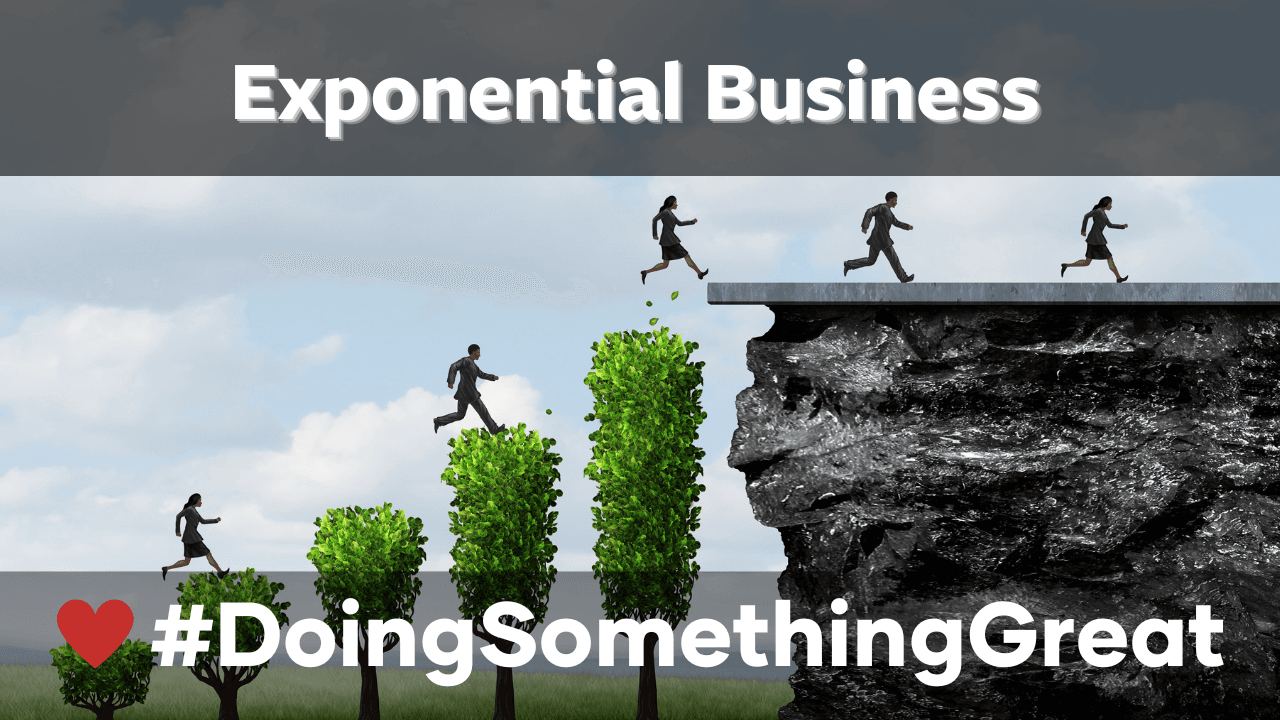
We celebrated DSG's 24th birthday this month, so I have been reflecting on our business and how to facilitate exponential growth in the next few years. Interestingly, Google was also founded in September 1998, and they are one of the biggest companies in the world today.
In a fast-paced digital world, companies must constantly think of new ways to keep up with the ever-changing needs of their customers. As consumers adapt to new technologies, a company's business design needs to be re-invented over and over again to remain customer relevant.
Moore's law has impacted nearly every aspect of our lives. Ever faster, cheaper computing power creates ever faster, cheaper industries. Computing power is driving the progression of society. It is the "engine of prosperity." - Michio Kaku
My background is consulting before I started DSG. I had a small ICT consulting firm, and my main reason for starting Digitalmall.com was to "make money while I sleep" rather than sell services and time. At the time of the dot com hype, 'Business as usual' companies were falling away. Agile, exponentially-minded companies were exploding onto the scene.
"The fact that nearly 9 of every 10 Fortune 500 companies in 1955 are gone, merged, or contracted demonstrates that there's been a lot of market disruption, churning, and Schumpeterian creative destruction over the last 60 years." 50 years ago, the life expectancy of a firm in the Fortune 500 was around 75 years. Today, it's less than 15 years and declining all the time.
What is an exponential business model?
A business model defines how value gets created and delivered in a company. It includes your value proposition, customer relationships, channels, customer segments, cost structures, and revenue streams. An exponential business model looks at the same key areas as a traditional business model but has radically different goals.
It looks at scale and how we grow a business 10X or more and make it multiply faster and exponentially, which companies like Google and Amazon did successfully by ignoring profits for many years, which allowed them to innovate and grow. Amazon did not make a profit for the first 14 years. This is only possible when you have a mature venture capital market that is forward-looking and is willing to invest in the long term.
As a solution provider, DSG is always looking to add value to our customers by creating more efficiency, saving the customer money or creating new revenue opportunities. Exponential business models are often built on sharing risk and success, whereby the client's success is our reward. It is based on key metrics and performance, and you can earn a percentage of the savings or new revenue generated and create a win/win business model with the customer.
Zig Ziglar succinctly says, "You can have everything in life that you want if you just give enough other people what they want." An exponential business, therefore, focuses on scaling a company's products, services, or technologies across a network of users to create exponential benefits for everyone involved.
Network effects and the power of compounding
We are hardwired to think linearly, but our technologies drive change at an exponential rate. We need to be more agile and recognise the changes, capitalise on the change, and catalyse or cause new changes.
A network effect occurs when a product or service becomes more valuable as more people use it. Brands can encourage network effects by offering their products or services for free for high adoption or "Freemium", where the service is free, but you earn money through advertising or other paid services, as per Google's or Meta's business models.
Exponential business models have a compounding effect which Albert Einstein described as "The greatest mathematical discovery of all time." Companies can leverage the compounding effect through Kaizen, Internet-centred approaches, Customer Devotion, On-demand staffing, Autonomous organizational structure, Impact-driven engagement, Crowdsourcing, Crowdfunding, and Algorithm-centred operations.
Exponential leadership
In our leadership, we can leverage the compounding effect through autonomy. Leaders should focus less on making decisions and more on empowering decisions within the organisation. An exponential mindset helps you become comfortable with uncertainty. You can't see around the bend like a winding road when riding an exponential curve.
To innovate, you must be willing to fail fast to learn through experimentation. "If you want to increase your success rate, double your failure rate." - Thomas J. Watson, Former CEO, IBM
It is important to remember that every industry and every company is different, and there is no perfect model that fits every business. Building an exponential business is like surfing. You let the wave push you; using exponential procedures, you stay on the wave and exercising exponential leadership steers you towards the next wave.
Are you looking to stay ahead of the curve in a digital world by harnessing the power of exponential business models? Catch the next wave. #DoingSomethingGreat