
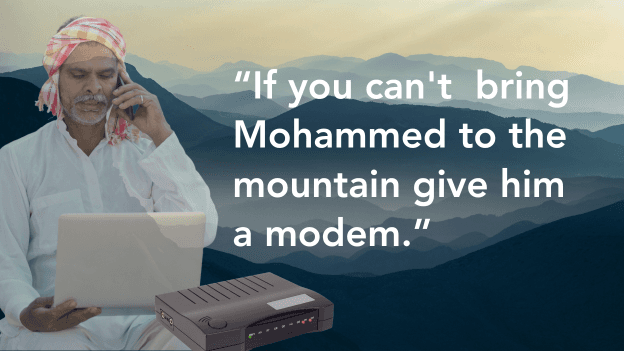
This was our first advert for www.digitalmall.com in the late nineties. There were few people on the Internet in South Africa then, and we were promoting people to connect to the Internet and shop online. Modems have been replaced with routers that offer fast connectivity via FTTH (Fibre to the Home) or FLTE (Fixed LTE). The old sound of a dial-up modem is long forgotten. It is no longer the "worldwide wait" and post-pandemic there has been a shift of consumer spending to buying online.
The number of online shoppers has increased considerably during the past ten years. In 2021, 74% of the EU population, who used the internet during the previous year, shopped online. Shopping on the web was particularly widespread in the Netherlands (94%), Denmark (92%) and Sweden (89%).
The advent of mobile money has made online shopping for the masses a reality in Africa, alleviating the need for credit or debit cards. Therefore, prepaid online shopping is immensely popular in Africa and will hopefully replace cash soon. Proven systems built on mobile connectivity and increasingly flexible means of exchange provide a tipping point in the shift towards a cashless society.
Mobile money and the African opportunity
The principle has been proven that innovation often occurs where the need for change is greatest. In Africa with poor physical infrastructures and a rural population often dependent on remittances from the city is where that technology can really demonstrate value by offering a secure, efficient alternative to cash transactions.
The success of products like M-PESA in Kenya (the cash handled by Safaricom's M-Pesa agents represents 31% of the country's 2021 gross domestic product) demonstrates that particularly in emerging economies, the majority of cash transactions have been replaced by digital ones, and most of these will be made by our phones.
Consumer-focused digital money transactions via mobile phone now cover banking services, transfers, and payments. Mobile-money firms are best placed to benefit from the disruption. Just 40% of Nigerians have access to bank accounts, compared with mobile-phone penetration of 117% in the country, giving them the opportunity to expand rapidly.
So, Mohammed can now store his money digitally as well, almost 25 years after we published the ad, and online shopping is mainstream.
The Gartner Hype Cycle
I like the metaphor that talks about what Gartner calls the "hype cycle" and the adoption curve of new technologies. Being a pioneer that often returned with "arrows in their back"!
Our focus these days is to let innovations mature before we simply educate the market, which is quite expensive, and then wait an extended period in the hype cycle to start seeing rewards.
According to Gartner, each hype cycle drills down into the five key phases of a technology's life cycle: Innovation Trigger, where a potential technology breakthrough kicks things off. Peak of Inflated Expectations, where early publicity produces success stories often accompanied by scores of failures. Trough of Disillusionment, where interest wanes as experiments fail to deliver. Slope of Enlightenment, where more instances of how the technology can benefit enterprise start to crystallize. Plateau of Productivity, where mainstream adoption starts to take off.
When it comes to innovation, timing is everything, so planning is key.
Climbing Kilimanjaro: A lesson in teamwork
Mountain climbing is a metaphor for teaching anything and as a metaphor for life. The grade of a climb might be the same as another route but the route to the same summit of the mountain is the same. There are many routes and ways to learn a concept or solve a problem.
My management team and I decided to climb Mount Kilimanjaro together as a team-building exercise. The mountain is thought to contain divine inspiration, and it is a universal symbol of the nearness of God, as it surpasses ordinary humanity and extends toward the sky. Due to its sheer height, the mountain usually symbolizes desires, dreams, and hopes.
We designed the team building to provide a memorable, emotionally gripping learning experience. When used as a learning tool, gamification is an effective way to achieve longer-lasting results in less time. Teams must strategize on how they plan to move up the mountain each day, weighing critical factors like weather conditions, strategic routes, air pressure acclimatization, oxygen use and fitness levels.
The sense of achievement, when you summit, is incredible and the serenity and beauty around you make the journey and effort worthwhile. Teamwork is essential to a company's success, says John J. Murphy, author of Pulling Together: 10 Rules for High-Performance Teamwork. "Each individual has unique gifts, talents, and skills. When we bring them to the table and share them for a common purpose, it can give companies a real competitive advantage."
#DoingSomethingGreat is understanding that many brains are better than one.